
Agentic AI in ITSM: Transforming Service Management with Autonomous Systems


IT service management has always been about keeping systems running and users productive. But the way we achieve that is fundamentally changing. Agentic AI represents a shift from tools that help you work faster to systems that can work independently, making decisions and taking action without constant human oversight.
McKinsey's latest modeling estimates that generative and agent-driven AI could inject $2.6 trillion to $4.4 trillion of new economic value annually. In ITSM specifically, early enterprise rollouts are already showing a 60% reduction in ticket volume. These are not speculative numbers. They reflect what happens when autonomous software agents absorb the routine work that once required Level 1 support staff.
Let's break down what agentic AI actually means for IT service management, how it works, and what you need to know to evaluate it for your organization.

What is agentic AI in IT service management?
Agentic AI refers to AI systems that behave like autonomous agents. They can operate independently, make context-aware decisions, pursue specific goals, and adapt their actions based on feedback from their environment. Think of it as the evolution from scripts and bots to "digital colleagues."
To understand why this matters, it helps to see how AI in ITSM has evolved:
Traditional automation uses rule-based systems to complete narrowly defined tasks. It works well for routing tickets or sorting requests where the logic is consistent and outcomes are predictable. But it cannot adapt when conditions change.
Generative AI brought the ability to create new content and understand natural language. Tools like ChatGPT showed that AI could interpret requests and generate helpful responses. But these systems cannot act independently. They suggest solutions, they do not execute them.
Agentic AI goes further. These systems can understand complex requests, analyze real-time context, make decisions, and take action across multiple systems without waiting for human input. They learn from outcomes to improve future decisions.
The key characteristics that define agentic AI in ITSM include:
Initiating actions without being explicitly asked for each step
Setting sub-goals to achieve broader objectives
Learning from experience and adapting behavior
Collaborating with humans and other AI agents to complete complex workflows
For example, when an employee reports a VPN issue, an agentic AI system does not just create a ticket. It identifies the issue type, gathers error logs and system stats, checks if the user is in a critical role, correlates with other similar reports, attempts automated remediation, and only escalates to a human if the fix fails. All of this happens in seconds, without manual intervention.
How agentic AI works in practice
The agentic AI workflow follows a continuous loop: perceive, reason, act, and learn.
Perception involves gathering data from multiple sources. The AI monitors ticketing systems, endpoint management platforms, network monitoring tools, and communication channels. It uses natural language processing to interpret user requests, even when they are vague or incomplete.
Reasoning is where the AI analyzes the information to identify goals and determine the best course of action. It weighs factors like business priority, historical incident data, end-user impact, and service level agreements. This contextual awareness is what separates agentic AI from simpler automation.
Execution means the AI initiates multi-step workflows across systems without waiting for human approval at each step. It might reset a password in Active Directory, update a ticket in ServiceNow, notify the user via Slack, and log the action for compliance, all as part of a single autonomous sequence.
Learning ensures the system improves over time. Every resolution (successful or not) feeds back into the model. The AI recognizes patterns in what worked and adjusts future responses accordingly.
Human oversight remains built into the system. Agents operate within defined boundaries and escalate when they encounter situations outside their authority or capability. Think of it like Tesla's Full Self-Driving mode: the AI handles the routine driving, but the human remains responsible and can intervene at any time.
Key use cases for agentic AI in ITSM
The most mature use cases for agentic AI in IT service management cluster around high-volume, structured workflows where the AI can make clear decisions based on available data.
Autonomous incident resolution
Self-healing systems represent the most visible impact of agentic AI. When the AI detects a server running low on resources, it can automatically reallocate capacity or restart services before users notice a problem. If an application shows degraded performance, the agent analyzes logs, identifies the root cause, and executes remediation scripts.
This is not theoretical. Aisera's platform proactively monitors systems and autonomously resolves incidents as they occur. Zendesk AI agents handle up to 80% of common support interactions without human intervention. The key is that these systems do not just detect problems. They fix them.

Intelligent ticket triage and routing
Traditional ticket routing relies on users selecting categories or simple keyword matching. Agentic AI understands context. It checks who the user is (a C-suite executive during payroll week versus a contractor), what the issue description actually means, whether similar issues have occurred recently, and which team has the right skills and capacity.
The result is tickets that arrive at the right team with relevant context already attached. The AI asks only the missing questions, minimizing back-and-forth. It reads screenshots and extracts error codes automatically. It sets priority based on business impact, not just the user's assessment.
Proactive problem detection
Agentic AI excels at spotting patterns across seemingly unrelated incidents. If employees in different locations start reporting Wi-Fi issues, the AI correlates these reports, identifies the common infrastructure component, and alerts IT before the problem spreads further.
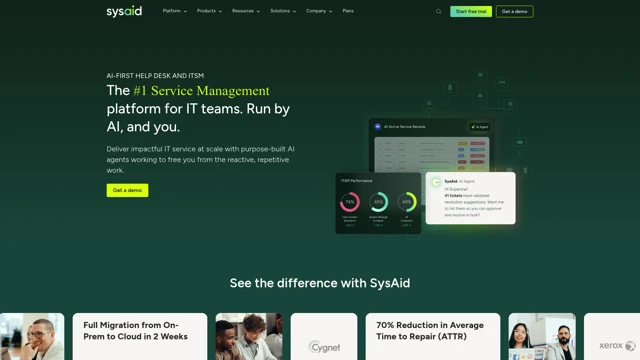
This shifts IT from reactive firefighting to proactive management. The AI continuously monitors for anomalies, forecasts potential incidents based on historical patterns, and resolves issues before they affect users. SysAid's AI emphasizes this proactive detection as a core capability.
Employee onboarding automation
Onboarding involves multiple departments: IT provisions accounts and hardware, HR handles paperwork and training, facilities assigns desks. Traditionally this requires manual coordination across siloed systems.
Agentic AI orchestrates the entire process. When HR marks a new hire in the system, the AI triggers workflows across all departments. The IT agent creates accounts, adds the user to appropriate groups, and provisions software licenses. The facilities agent assigns a desk and updates seating charts. The HR agent schedules orientation sessions.
All of this happens in parallel, with the AI managing dependencies and keeping everyone informed.
ManageEngine's documentation provides detailed examples of this multi-agent orchestration across IT, HR, and facilities.
Knowledge management and creation
Every resolved incident contains knowledge that could help future cases. Agentic AI extracts insights from resolution notes, automatically generates or updates knowledge base articles, and surfaces relevant information during live support interactions.
When a technician resolves a complex issue, the AI suggests creating a KB article from the resolution steps. It identifies which past incidents had similar symptoms and links them to the new solution. When a user opens a ticket, the AI recommends relevant articles based on the issue description, often resolving the problem before a human agent gets involved.
Business benefits and ROI
The business case for agentic AI in ITSM rests on measurable improvements in efficiency, cost reduction, and service quality.
Quantified benefits from industry research include:
Metric | Impact | Source |
Ticket volume reduction | Up to 60% | ITSM.tools analysis of McKinsey modeling |
Autonomous resolution rate | Up to 80% of common interactions | |
Resolution speed improvement | Up to 40% faster through parallel processing | |
Mean time to resolution (MTTR) | Significant reduction through automation |
Cost savings come from reducing the manual effort required for routine tasks. When AI handles password resets, account unlocks, and software provisioning, human agents can focus on complex issues that require judgment and creativity. This is not about replacing people. It is about letting people do work that matters instead of repetitive tasks.
Employee experience improves because issues get resolved faster, often without the user needing to wait for a human agent. The AI operates 24/7, handles multiple conversations simultaneously, and provides consistent service quality regardless of volume spikes.
Strategically, agentic AI enables IT teams to shift from reactive maintenance to proactive improvement. When routine work is automated, IT staff have time for projects that drive business value: optimizing systems, implementing new capabilities, and preventing problems before they occur.

How to get started with agentic AI in your ITSM stack
Agentic AI is quickly becoming table stakes for modern IT operations. And the question now being asked is how to do it safely, pragmatically, and in a way that fits your current tools and processes.
That’s where Onpoint comes in. We help IT teams design and implement agentic AI in a way that’s practical, governed, and measurable. Using Rovo as an intelligent layer across tools like Jira Service Management, Confluence, Slack, and your existing ITSM platforms, we orchestrate end‑to‑end workflows: triage and routing, autonomous resolution, knowledge creation, and human handoff when it matters. Instead of ripping and replacing your stack, we plug agentic capabilities into what you already use, with clear guardrails, KPIs, and change management support so your team stays in control.
If you’re exploring where to start—whether that’s a narrow use case like password resets and onboarding, or a broader AI roadmap for IT operations—Onpoint can help you run a focused pilot, prove value quickly, and scale with confidence.
Frequently Asked Questions
What is the difference between agentic AI for ITSM and traditional IT automation?
Traditional automation follows predefined rules and cannot adapt to new situations. Agentic AI can understand context, make decisions, and take actions across multiple systems without explicit programming for each scenario. It learns from experience and improves over time, whereas traditional automation performs the same way indefinitely.
How much does it cost to implement agentic AI for ITSM?
Costs vary significantly by platform and scope. Zendesk offers transparent pricing starting at $55 per agent per month for AI capabilities. ServiceNow, Aisera, and Konverso require custom quotes based on organization size and requirements. Beyond licensing, factor in implementation services, integration work, and change management. Most organizations see positive ROI within 6-12 months through reduced ticket volumes and faster resolution times.
Will agentic AI replace IT support staff?
No. Agentic AI augments human capabilities rather than replacing them. The technology handles routine, repetitive tasks, allowing human agents to focus on complex issues requiring judgment, creativity, and empathy. IT staff transition from executing routine work to supervising AI workflows, handling escalations, and improving systems. Most organizations find they can handle growth without proportional hiring increases, rather than reducing headcount.


Comments