
Human-AI Collaboration in 2026: A Practical Guide for Teams

Three years after ChatGPT entered the mainstream, AI has moved from experimental curiosity to workplace essential. However, it is becoming clearer that the organisations seeing real returns aren't the ones with the biggest AI budgets. They're the ones that figured out how to make humans and AI work together.
According to the latest Harvard Business Review survey of 100+ C-level executives, 99% now prioritize AI investments. Yet 93% of those same leaders cite human and cultural issues, not technology, as their biggest adoption barrier. The challenge isn't getting AI to work. It's getting people to work with AI.
This guide covers what AI collaboration actually looks like in 2026, why most implementations struggle, and how to prepare your organization for a future where your coworkers might not all be human.
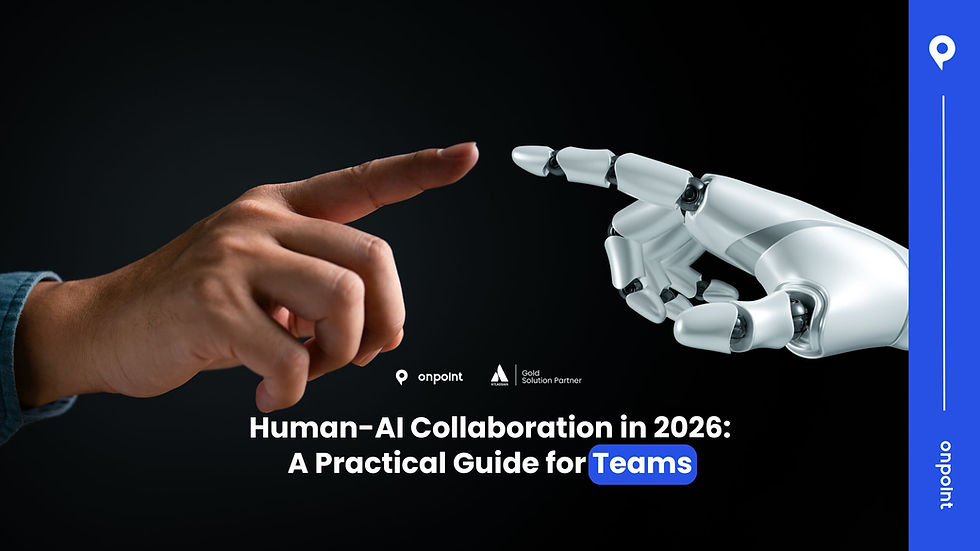
AI collaboration is now a daily reality for millions of workers across industries.
What using AI for collaboration looks like in 2026
Let's start with a definition. AI collaboration isn't about automation, where machines replace human tasks. It's about symbiosis, where humans and AI combine complementary strengths to achieve outcomes neither could reach alone.
Cisco calls this framework "Connected Intelligence" and it encompasses three distinct collaboration modes:
Human-to-human collaboration enhanced by AI (real-time translation, smart scheduling, automated note-taking)
Human-to-AI collaboration where AI acts as a teammate (brainstorming, analysis, content creation)
AI-to-AI collaboration where multiple agents coordinate tasks autonomously
The big shift for 2026 is the rise of agentic AI. These aren't chatbots that respond to prompts. They're digital coworkers that can take initiative, manage workflows, and make decisions within defined boundaries. Microsoft's chief product officer Aparna Chennapragada describes it this way: "The future isn't about replacing humans. It's about amplifying them."
Here's what this looks like in practice. A three-person marketing team can now launch a global campaign in days instead of weeks. AI handles data analysis, content generation, and personalization while humans steer strategy and creativity. Developers pair with GitHub Copilot in real time, not just for code completion but for architectural decisions. Knowledge workers brainstorm with AI inside Teams meetings, surfacing insights that would take hours to research manually.
The numbers back this up. ADP Research found 43% of workers now use generative AI frequently at work. Stanford's AI Index Report shows 78% of companies used AI in 2024, up 55% from the previous year. Adoption is outpacing the internet's growth in the early 2000s.
Connected Intelligence encompasses all three collaboration types working together seamlessly.

Why work redesign matters more than technology
Here's a hard truth: most AI implementations fail not because the technology doesn't work, but because organizations treat it like a software upgrade instead of a workflow transformation.
Mercer's Global Talent Trends 2026 report surveyed nearly 12,000 business executives, HR leaders, and employees worldwide. They found 63% of C-suite leaders believe redesigning work for AI and automation will yield the highest people-related ROI in 2026. Yet only about one-third feel their workforce is currently equipped to combine human and AI capabilities effectively.
The problem? Organizations are substituting old approaches with technology rather than transforming how work gets done. They're asking "How can AI do what we currently do faster?" instead of "What should we do differently now that AI is possible?"
Work redesign means deconstructing, redeploying, and reconstructing workflows to optimize human-AI collaboration. It requires understanding what humans do best (judgment, creativity, ethical reasoning, navigating ambiguity) and what AI does best (processing at scale, pattern detection, consistent execution without fatigue).
For example, in professional services, consultants now use AI to draft proposals and synthesize research. But the human still refines, contextualizes, and applies expertise. The result is higher-quality work delivered faster, not consultants replaced by algorithms.
This is where Microsoft Dynamics 365 Business Central becomes relevant. ERP systems that centralize finance, inventory, sales, and marketing data create the foundation for AI collaboration. When your data lives in disconnected spreadsheets, AI has nothing meaningful to work with. Centralized systems enable AI to surface insights across departments, automate routine workflows, and support human decision-making with real-time data.
Building security and trust into AI collaboration
As AI agents gain access to sensitive systems and data, security becomes non-negotiable. Microsoft's corporate vice president of security Vasu Jakkal puts it bluntly: "Every agent should have similar security protections as humans... to ensure agents don't turn into 'double agents' carrying unchecked risk."
The HBR survey found 79% of organizations now view responsible AI as a top corporate priority, up from 69% last year. Ninety percent report safeguards and governance are in place, up from 62% two years ago.
Practical security measures for AI collaboration include:
Agent identity management — Each AI agent needs a clear identity, just like human employees
Access controls — Limit what information and systems each agent can access based on role
Data management — Track what data agents create, access, and modify
Audit trails — Maintain records of AI decisions and actions for compliance and troubleshooting
Threat protection — Defend AI agents from attackers who might try to manipulate them
The principle is simple: trust is the currency of innovation. Organizations that build security in from the start will move faster long-term than those who treat it as an afterthought.
For IT teams managing this transition, Jira Service Management provides a framework for controlling AI agent access, tracking their activities, and ensuring compliance. As AI agents proliferate, ITSM tools become essential for managing the "digital workforce" alongside human employees.
Addressing the human side of using AI for collaboration
Technology moves fast. People don't. And that disconnect is the single biggest barrier to AI collaboration success.
The HBR survey found 93% of executives cite human issues, culture, and change management as the key challenge to AI adoption. This is the highest percentage ever recorded in their fifteen-year survey history. Only 7% blame technology limitations.
Employee anxiety is rising. Mercer's research shows concern about AI-driven job loss surged from 28% in 2024 to 40% in 2026. Sixty-two percent of employees feel leaders underestimate AI's emotional and psychological impact. Yet only 19% of HR leaders consider these impacts as part of their digital implementation strategy.
This is a recipe for resistance, shadow IT usage, and failed implementations.
The solution starts with skills development. As Mercer's Ravin Jesuthasan notes, "skills, not jobs, become the new currency in the workplace." Fifty-three percent of employees worry about lacking future-ready skills. Forty-seven percent worry about their skills staying relevant, up from just 17% in 2024.
Building an AI-literate workforce requires:
AI fluency programs that teach employees how to interpret AI recommendations and evaluate outputs
Transparent AI systems that employees can understand and trust
Involvement in work redesign so employees shape how AI integrates into their roles
Continuous upskilling rather than one-time training sessions
On Point Academy offers training programs that help teams become "industry ready" for AI collaboration. Their approach focuses on practical skills, not theoretical knowledge, ensuring employees can work effectively alongside AI systems from day one.
Common pitfalls when using AI for collaboration
Learning from others' mistakes saves time and money. Here are the most common ways AI collaboration initiatives fail:
Siloed implementation. IT builds AI tools without understanding business workflows. Business users reject tools that don't fit their actual needs. The fix: involve end-users in design from day one.
Ignoring the emotional impact. Leaders focus on productivity gains while employees worry about job security. The fix: address anxiety directly through transparent communication and reskilling programs.
Treating AI as replacement rather than augmentation. When employees see AI as a threat, they resist. When they see it as a multiplier, they embrace it. The fix: frame AI as handling repetitive work so humans can focus on higher-value tasks.
Insufficient skills investment. Only 50% of C-suite leaders agree they're investing enough to close the skills gap they expect tomorrow. The fix: budget for training as a core implementation cost, not an afterthought.
Security as afterthought. AI agents with broad system access create new attack surfaces. The fix: implement identity and access management for AI agents from the start.
Preparing your organization for AI collaboration
The organizations that thrive with AI collaboration share common traits. They start with leadership alignment and a clear AI strategy that connects to business outcomes. They invest in upskilling before rollout, ensuring employees are ready to work alongside AI. They create feedback mechanisms for continuous improvement, treating AI collaboration as an evolving capability, not a one-time project.
Most importantly, they partner with experienced implementation consultants who understand both the technology and the human factors. On Point Ltd brings over 22 years of ERP experience and deep expertise in Microsoft Dynamics 365 Business Central, Atlassian solutions, and IT service management. Their "hand holding" approach guides clients through every stage of deployment, ensuring technology investments actually deliver business value.
The future of work isn't humans versus AI. It's humans with AI, working in symbiosis. Organizations that embrace this reality, redesign their workflows, and invest in their people will gain a measurable competitive advantage. Those that don't risk falling behind as the pace of change accelerates.
Frequently asked questions about using AI for collaboration in 2026
Q1: What does using AI for collaboration in 2026 actually mean for day-to-day work?
A1: It means AI acts as a teammate rather than just a tool. In practice, this looks like AI agents that can draft documents, analyze data, schedule meetings, and handle routine communications autonomously while humans focus on strategy, creativity, and complex decision-making. Instead of asking AI to perform specific tasks, you'll collaborate with AI systems that understand context and can take initiative.
Q2: How can small businesses start using AI for collaboration without massive budgets?
A2: Start with tools you already use. Microsoft 365, Google Workspace, and Atlassian products all have built-in AI features at no extra cost. Focus on one high-impact workflow, like meeting transcription or document summarization. Pilot with a small team, measure results, and expand based on what works. The barrier to entry has never been lower, many effective AI collaboration tools are available for less than $20 per user per month.
Q3: What are the biggest security risks when using AI for collaboration in 2026?
A3: The main risks are unauthorized data access by AI agents, "prompt injection" attacks that manipulate AI behavior, and lack of audit trails for AI decisions. Mitigate these by implementing identity management for AI agents (treating them like employees), restricting access based on role, monitoring AI activities, and maintaining human oversight for sensitive decisions.
Q4: How do you measure ROI from using AI for collaboration?
A4: Track both quantitative metrics (time saved, tasks completed, error rates) and qualitative metrics (employee satisfaction, perceived value, stress levels). Before implementing, establish baseline measurements. After rollout, survey employees monthly about their experience. The best ROI indicator is when employees voluntarily expand AI usage to new workflows because they're seeing personal benefits.
Q5: Will using AI for collaboration in 2026 eliminate jobs?
A5: Research suggests augmentation, not replacement, is the dominant pattern. The World Economic Forum emphasizes that AI handles repetitive tasks while humans focus on judgment, creativity, and relationships. Jobs will change, some tasks will disappear, but new roles managing AI systems and interpreting AI outputs will emerge. Organizations that communicate this honestly and invest in reskilling see higher adoption and lower anxiety.
Q6: What skills do employees need for effective AI collaboration?
A6: The three critical skills are: (1) AI fluency, understanding how to prompt, evaluate, and refine AI outputs; (2) critical thinking, knowing when to trust AI recommendations and when to question them; and (3) contextual judgment, applying human expertise to AI-generated insights. Technical coding skills matter less than the ability to collaborate effectively with intelligent systems.
Q7: How long does it take to implement AI collaboration successfully?
A7: Most organizations see initial results within 3-4 months of pilot launch, but full transformation takes 12-18 months. The timeline depends on data readiness, employee training, and change management investment. Organizations that rush implementation without proper preparation often face resistance and require 6+ months of remediation. Patience in planning pays dividends in adoption.


Comments